Rebuilding Software Years Later: Preserving Dependencies for Long-Lived IoT Devices
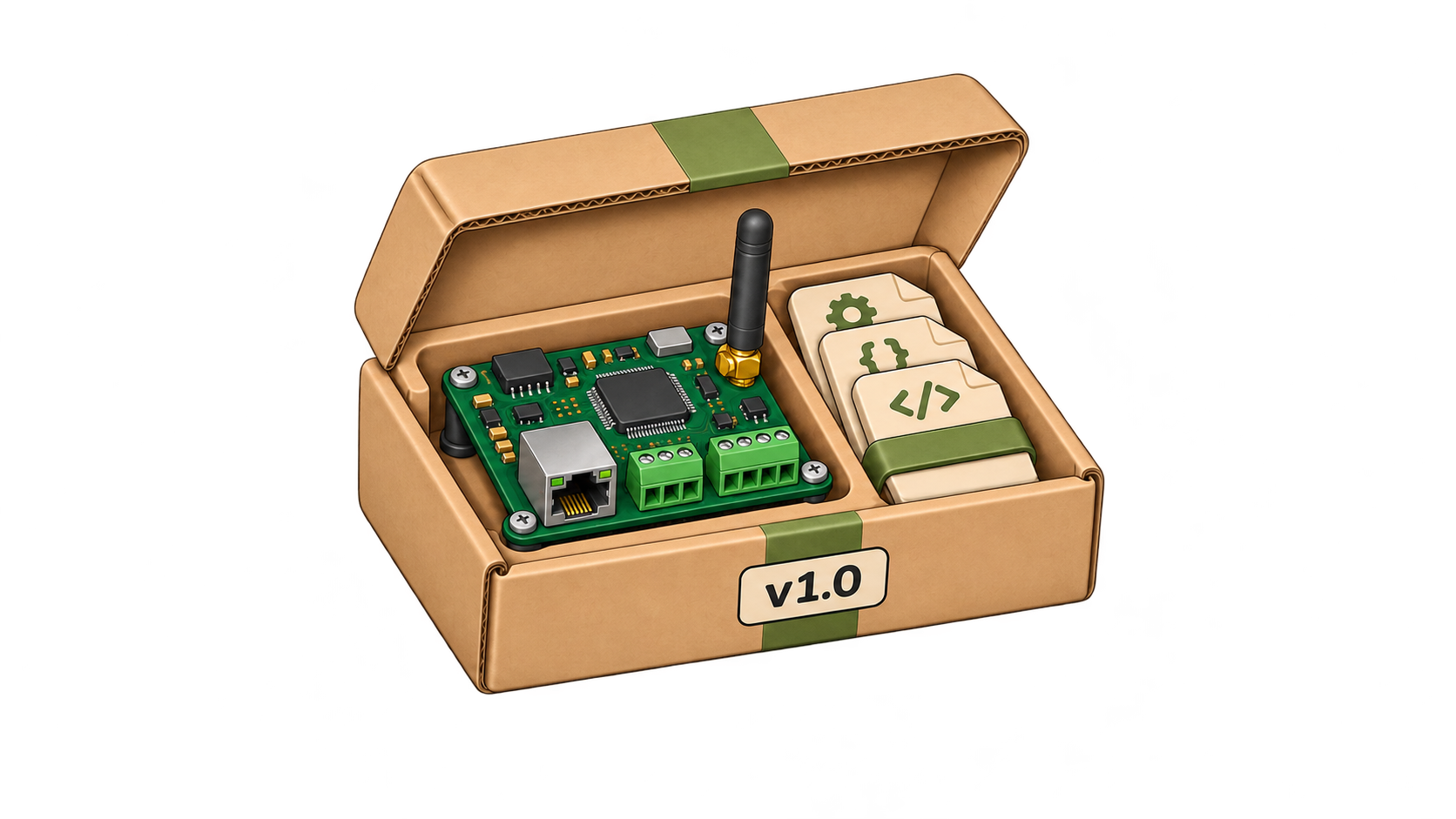
An IoT device can remain in service long after the development environment used to create its software has changed.
A gateway deployed in a factory, a sensor installed in a building, or an embedded controller operating in the field may need maintenance years after its original release. When a security vulnerability is discovered or a customer reports a problem, engineers may need to rebuild the software running on that device.
The source code might still be available in Git. But the compiler, operating system packages, SDKs, and other dependencies used to build it may have changed or disappeared.
For teams maintaining long-lived IoT devices, this creates a practical challenge: preserving the ability to rebuild and update software throughout the device's supported lifetime.
Reliable dependency preservation helps make that possible.
Why rebuilding IoT software becomes harder over time.
Many software applications can move to newer platforms or infrastructure as their requirements change. Embedded devices often have less flexibility.
A device may use a processor architecture, operating system, or hardware interface that was selected years earlier. Its firmware may depend on a particular compiler, board support package, or vendor-provided library.
Replacing those components is not always straightforward.
A newer SDK might no longer support the hardware. An updated compiler might produce a different binary or expose assumptions in older code. A dependency might have been removed from its original download location.
These problems become especially relevant during firmware rebuilds.
Consider a team maintaining industrial monitoring equipment. The original firmware was developed in 2022, and the devices are still deployed in 2026.
A customer reports a problem that requires a small firmware change. The engineering team retrieves the source code, checks out the release tag, and attempts to rebuild the firmware.
The build fails because a required dependency is no longer available.
The team now has two problems: fixing the customer's issue and reconstructing the development environment that originally produced the firmware.
The second problem may require more work than the first.
Source code alone is not enough to reproduce firmware.
A Git repository can preserve source code and build configuration, but it does not automatically preserve everything a build downloads from external sources.
A typical embedded software build may rely on several inputs:
Build input
Why it matters years later
Cross-compilation toolchain
Different compiler versions may produce different binaries
Board support package
Hardware-specific files may only work with particular platform releases
Operating system packages
Required versions may be replaced or removed
Container images
Tags may change or images may disappear
Vendor SDKs
Older releases may no longer be hosted
Downloaded archives
External URLs can change or stop working
Python build tools
Package versions and transitive dependencies may change
These embedded software dependencies are part of the build environment, even when they are not committed to the application's repository.
Consider a simplified Dockerfile used to create an embedded Linux build environment:
The Dockerfile specifies the Ubuntu release and the packages required for the build.
However, it does not freeze the exact versions of those packages.
If the same Dockerfile runs several years later, the repositories may contain different package versions. The base image referenced by ubuntu:22.04 may also have changed.
The source code is unchanged, but the environment used to compile it may no longer match the original environment.
For reproducible embedded builds, controlling these external inputs is essential.
What happens when an older dependency disappears?
An old build can fail even when its configuration specifies an exact package version.
Version pinning tells the package manager which version to request. It does not guarantee that the package will remain available from the upstream repository.
For example, a project might require a specific toolchain package released several years ago.
If that package has been removed from the repository, the build cannot retrieve it through the source.
The same problem can occur with Docker images, Python packages, and vendor SDK downloads.
The problem is particularly difficult when only a small software change is required. Engineers may have to upgrade multiple dependencies to recreate a working build environment.
Those upgrades can introduce unrelated differences, making it harder to understand whether a new firmware release behaves as expected.
This is why SDK version pinning and package version records are useful but incomplete on their own.
The required files also need to remain accessible.
Why Docker images do not solve the entire problem
Containers are useful for packaging development environments.
An engineering team can create an image containing a compiler, build tools, and system libraries, then use that image across multiple developers and CI systems.
This reduces differences between local machines and build servers.
However, a Docker image tag is not necessarily immutable.
A tag can be updated to reference different image content. An image can also become unavailable from its upstream registry.
Using immutable Docker images, identified by a particular image digest or retrieved from a preserving mirror, provides stronger control over the container environment.
That still leaves dependencies downloaded during the build.
For example, a Docker build may retrieve packages through APT, install Python tools through pip, or download a vendor SDK from an external URL.
Even when the base image remains unchanged, those additional downloads can introduce differences.
To reliably maintain an older build, teams need to account for both the container image and the dependencies retrieved inside it.
The challenge for embedded Linux and Yocto-based projects
The problem extends beyond Docker-based development environments.
Many embedded devices use customized Linux distributions created with tools such as the Yocto Project.
A Yocto-based build can depend on source repositories, release archives, patch files, metadata, and build tools.
The Yocto Project provides mechanisms to download and cache source files. BitBake also supports pre-mirrors and alternative mirror locations through configuration variables such as PREMIRRORS and MIRRORS.
These mechanisms help engineers control where build inputs are retrieved.
However, local caches and externally hosted mirrors still need to be maintained if they are expected to support historical builds.
For long-term embedded Linux builds, the important question is whether the required files will still be available when the project needs them again.
A build system can record the correct revision, but it cannot retrieve a missing file unless another accessible copy exists.
Maintaining historical dependencies therefore becomes part of the product's long-term support strategy.
Historical package mirrors make older builds easier to maintain
A conventional package mirror generally provides an alternative location for retrieving software packages.
It may improve download performance or availability, but it can still follow changes made to the upstream repository.
Historical package mirrors serve a different purpose.
They preserve repository content or package states associated with earlier points in time, allowing engineers to retrieve packages that were available when an older build was created.
This matters when rebuilding software for a device deployed years ago.
Suppose an embedded Linux application was built using a particular set of Ubuntu packages.
When the engineering team needs to recreate that environment later, it can use the preserved repository state instead of relying on whatever packages the current upstream repository provides.
This allows the team to investigate an older release without introducing unrelated package updates simply because the original versions are no longer available.
Historical mirrors address a specific part of reproducibility: ensuring that external dependencies remain retrievable.
Other details, including compiler configuration, timestamps, build paths, and hardware-specific behavior, may still affect the final build output.
How StableBuild helps preserve long-term build dependencies
StableBuild provides immutable and historical mirrors for external software dependencies.
Its supported sources include Docker images, Ubuntu, Debian, and Alpine packages, Python packages, and files downloaded from external URLs.
These capabilities matter for IoT development because embedded software often depends on a mix of operating system packages, containers, toolchains, and externally hosted files.
StableBuild's Docker mirror preserves images retrieved through the service, helping teams retain access even if an upstream image changes or is removed.
Its operating system package mirrors maintain historical repository snapshots, allowing teams to select package sources tied to specific dates.
For other build inputs, StableBuild's file-mirroring capabilities can help preserve files retrieved from external URLs.
Rather than requiring teams to build and maintain separate historical repositories for every dependency type, StableBuild fits into existing package-management and container workflows.
Developers can continue using familiar tools such as Docker, APT, APK, and pip while directing supported dependency requests through StableBuild.
For teams maintaining older embedded software, this reduces one source of uncertainty when rebuilding an earlier release.
An important detail is that dependencies need to be preserved while they are still obtainable. A mirror cannot necessarily recover a historical file that disappeared before it was captured.
StableBuild was recently included on the Reproducible Builds project's Success Stories and Involved Projects pages. This recognition highlights StableBuild's work on an important part of software reproducibility: keeping external build dependencies available when developers need to recreate an earlier environment.
Planning for maintenance before devices are deployed
Long-term build reliability is easier to establish before a product ships than years afterward.
Engineering teams can make future maintenance more predictable by treating external dependencies as part of their release records.
Record the complete build environment. Track source revisions, compiler versions, SDK releases, container image digests, target architecture, and package dependencies.
Preserve external artifacts. Make sure required container images, package files, toolchain archives, and other downloads remain accessible through an appropriate long-term storage or mirroring strategy.
Test historical rebuilds. Periodically rebuild an earlier firmware release using its recorded inputs. This helps identify missing dependencies before an urgent maintenance request arrives.
Separate maintenance patches from dependency upgrades. When a device requires a bug fix, preserving the original environment makes it easier to evaluate that change without introducing unrelated updates.
Plan for security updates. Preserving an older environment does not mean keeping vulnerable software in production. Teams still need a process for evaluating security fixes, upgrading dependencies, and testing updated firmware.
These practices help engineers support devices throughout their operational lives, not just during initial development.
Why this matters for IoT software updates
Supporting deployed devices requires more than creating the original firmware.
Teams may need to investigate security vulnerabilities, maintain compatibility with older hardware, and issue IoT software updates long after the initial release.
The National Institute of Standards and Technology (NIST) emphasizes cybersecurity planning throughout the IoT product lifecycle, including software update capabilities and ongoing manufacturer support.
Being able to reproduce an older build can make that maintenance work easier.
If a problem appears after an update, engineers can compare the new release with a known historical environment. If a vulnerability is found in a specific dependency, they can identify which releases used it and develop an appropriate fix.
Preserved dependencies support those investigations by keeping historical build inputs available.
For products deployed across industrial, commercial, or remote environments, this can reduce the effort required to maintain software that cannot simply be replaced with the latest platform.
Build for the device's lifetime, not just its launch.
A successful firmware release is only the beginning of an IoT product's software lifecycle.
Years later, the device may still need updates, troubleshooting, or a rebuild of an earlier release. At that point, access to the original compiler, packages, SDKs, and other dependencies can be just as important as access to the source code.
Teams that preserve these inputs before they disappear are better prepared to maintain their products over time.
StableBuild simplifies that process by preserving supported external dependencies through historical, immutable mirrors.
For teams building products that need to remain maintainable for years, dependency availability should be planned from the beginning.
Explore StableBuild's dependency mirroring features to see how they can support long-term embedded software maintenance.